Mike Fisher Mike Fisher
0 Course Enrolled • 0 Course CompletedBiography
Reliable CIPS L6M2 Exam Bootcamp | Exam L6M2 Questions Answers
After the advent of the PassLeaderVCE's latest CIPS certification L6M2 exam practice questions and answers, passing CIPS certification L6M2 exam is no longer a dream of the IT staff. All of PassLeaderVCE's practice questions and answers about CIPS Certification L6M2 Exam have high quality and 95% similarity with the real exam questions. PassLeaderVCE is worthful to choose. If you choose PassLeaderVCE's products, you will be well prepared for CIPS certification L6M2 exam and then successfully pass the exam.
CIPS L6M2 Exam Syllabus Topics:
| Topic | Details |
|---|---|
| Topic 1 |
|
| Topic 2 |
|
| Topic 3 |
|
| Topic 4 |
|
>> Reliable CIPS L6M2 Exam Bootcamp <<
Exam L6M2 Questions Answers & Latest Braindumps L6M2 Book
The versions of our product include the PDF version, PC version, APP online version. Each version’s using method and functions are different and the client can choose the most convenient version to learn our L6M2 exam materials. For example, the PDF version is convenient for you to download and print our L6M2 test questions and is suitable for browsing learning. If you use the PDF version you can print our L6M2 test torrent on the papers and it is convenient for you to take notes. You can learn our L6M2 Test Questions at any time and place. The APP online version is used and designed based on the web browser. Any equipment can be used if only they boost the browser. It boosts the functions to stimulate the exam, provide the time-limited exam and correct the mistakes online. There are no limits for the equipment and the amount of the using persons to learn our L6M2 exam materials. You can decide which version to choose according to your practical situation.
CIPS Global Commercial Strategy Sample Questions (Q16-Q21):
NEW QUESTION # 16
SIMULATION
Examine how an organisation can strategically position itself within the marketplace.
Answer:
Explanation:
How an Organization Can Strategically Position Itself in the Marketplace Strategic positioning is the process by which an organization differentiates itself from competitors and establishes a strong, sustainable presence in the market. It involves making key decisions regarding branding, pricing, customer engagement, and competitive advantage to attract and retain customers.
Below are the key strategies an organization can use to position itself strategically in the marketplace:
1. Competitive Strategy (Porter's Generic Strategies)
Organizations can use Michael Porter's Competitive Strategies to define their market position:
Cost Leadership - Competing on price by offering the lowest-cost products or services.
Differentiation - Offering unique, high-quality, or innovative products that stand out.
Focus (Niche Strategy) - Targeting a specific market segment with specialized products or services.
Example:
Aldi (Cost Leadership) keeps prices low by optimizing supply chains.
Apple (Differentiation) uses innovation and brand exclusivity to dominate the premium tech market.
Rolls-Royce (Focus Strategy) targets a niche luxury segment instead of mass markets.
2. Strong Branding and Market Perception
Organizations must build a strong brand identity to differentiate themselves. This includes:
✅ Consistent Branding - Using logos, colors, and messaging that reinforce identity.
✅ Emotional Connection - Telling a brand story that resonates with customers.
✅ Trust and Reputation - Delivering quality products and services to establish credibility.
Example:
Coca-Cola uses global branding to evoke happiness and refreshment, maintaining strong market dominance.
Tesla markets itself as an innovative, eco-friendly brand, appealing to environmentally conscious consumers.
3. Innovation and Product Development
To maintain a competitive edge, companies must invest in innovation and continuously improve their products/services.
✅ Technology Adoption - Implementing cutting-edge solutions (e.g., AI, automation).
✅ Customer-Centric Innovation - Developing products based on customer needs.
✅ First-Mover Advantage - Being the first to introduce groundbreaking products.
Example:
Amazon's AI-driven supply chain ensures fast deliveries and high customer satisfaction.
Netflix's streaming model revolutionized entertainment consumption, making it an industry leader.
4. Digital Transformation and Market Reach
Organizations can use digital tools and platforms to enhance their strategic positioning:
✅ E-commerce & Online Presence - Expanding reach beyond physical locations.
✅ Social Media & Influencer Marketing - Engaging with customers through digital channels.
✅ Data Analytics - Using customer insights to make strategic decisions.
Example:
Nike's e-commerce growth and direct-to-consumer (DTC) model strengthened its competitive position.
Zara's fast fashion strategy, driven by data analytics, allows quick response to trends.
5. Sustainability and Corporate Social Responsibility (CSR)
Modern consumers prefer brands that demonstrate social and environmental responsibility. Companies can differentiate themselves by:
✅ Sustainable Sourcing - Using eco-friendly materials and ethical suppliers.
✅ Corporate Ethics - Promoting fair labor practices and social initiatives.
✅ Carbon Footprint Reduction - Committing to green energy and carbon neutrality.
Example:
Patagonia's sustainability-first strategy attracts eco-conscious consumers.
Unilever's "Sustainable Living Plan" enhances brand loyalty through ethical business practices.
6. Strategic Partnerships and Market Expansion
Organizations can strengthen their market position through collaborations and global expansion:
✅ Mergers & Acquisitions - Gaining market share by acquiring competitors.
✅ Joint Ventures - Partnering with companies for mutual growth.
✅ New Market Entry - Expanding into emerging markets.
Example:
Google acquiring YouTube enhanced its presence in digital content.
Starbucks' partnership with Nestlé expanded its global coffee distribution.
Conclusion
Strategic positioning requires a clear understanding of competitive advantage, market needs, and innovative growth strategies. By leveraging cost leadership, differentiation, branding, innovation, digital transformation, sustainability, and partnerships, organizations can sustain long-term success in a competitive market.
NEW QUESTION # 17
SIMULATION
Discuss the following strategic decisions, explaining the advantages and constraints of each: Market Penetration, Product Development and Market Development.
Answer:
Explanation:
Evaluation of Strategic Decisions: Market Penetration, Product Development, and Market Development Introduction Strategic decisions in business involve selecting the best approach to grow market share, increase revenue, and sustain competitive advantage. According to Ansoff's Growth Matrix, businesses can pursue four strategic directions:
Market Penetration (expanding sales in existing markets with existing products) Product Development (introducing new products to existing markets) Market Development (expanding into new markets with existing products) Diversification (introducing new products to new markets) This answer focuses on Market Penetration, Product Development, and Market Development, discussing their advantages and constraints.
1. Market Penetration (Increasing sales of existing products in existing markets) Explanation:
Market penetration involves increasing market share by:
✅ Encouraging existing customers to buy more.
✅ Attracting competitors' customers.
✅ Increasing promotional efforts.
✅ Improving pricing strategies.
Example: Coca-Cola uses aggressive marketing, promotions, and pricing strategies to increase sales in existing markets.
Advantages of Market Penetration
✔ Low Risk - No need for new product development.
✔ Cost-Effective - Uses existing infrastructure and supply chain.
✔ Builds Market Leadership - Strengthens brand loyalty and customer retention.
✔ Quick Revenue Growth - Increased sales generate higher profits.
Constraints of Market Penetration
❌ Market Saturation - Limited growth potential if the market is already saturated.
❌ Intense Competition - Competitors may retaliate with price cuts and promotions.
❌ Diminishing Returns - Lowering prices to attract customers can reduce profitability.
Strategic Consideration: Businesses should assess customer demand and competitive intensity before implementing a market penetration strategy.
2. Product Development (Introducing new products to existing markets)
Explanation:
Product development involves launching new or improved products to meet evolving customer needs. This can include:
✅ Innovation - Developing new features or technology.
✅ Product Line Extensions - Introducing variations (e.g., new flavors, models, packaging).
✅ Customization - Tailoring products to specific customer preferences.
Example: Apple frequently launches new iPhone models to attract existing customers.
Advantages of Product Development
✔ Higher Customer Retention - Keeps existing customers engaged with new offerings.
✔ Brand Differentiation - Strengthens competitive advantage through innovation.
✔ Increases Revenue Streams - Expands product portfolio and market opportunities.
Constraints of Product Development
❌ High R&D Costs - Requires investment in innovation and testing.
❌ Market Uncertainty - New products may fail if not aligned with customer needs.
❌ Risk of Cannibalization - New products may reduce sales of existing products.
Strategic Consideration: Businesses should conduct market research, prototyping, and feasibility analysis before launching new products.
3. Market Development (Expanding into new markets with existing products) Explanation:
Market development involves selling existing products in new geographical areas or customer segments. Strategies include:
✅ Expanding into international markets.
✅ Targeting new demographics (e.g., different age groups or industries).
✅ Entering new distribution channels (e.g., e-commerce, retail stores).
Example: McDonald's expands into new countries, adapting its menu to local preferences.
Advantages of Market Development
✔ Access to New Revenue Streams - Increases customer base and sales.
✔ Diversifies Market Risk - Reduces dependency on a single region.
✔ Leverages Existing Products - No need for costly product innovation.
Constraints of Market Development
❌ Cultural and Regulatory Barriers - Differences in consumer behavior, legal requirements, and competition.
❌ High Entry Costs - Requires investment in marketing, distribution, and local partnerships.
❌ Operational Challenges - Managing supply chains and logistics in new markets.
Strategic Consideration: Businesses should conduct market analysis and risk assessments before expanding internationally.
Conclusion
Each strategic decision has unique benefits and challenges:
✅ Market Penetration is low-risk but limited by market saturation.
✅ Product Development drives innovation but requires high investment.
✅ Market Development expands revenue streams but involves cultural and regulatory challenges.
The best approach depends on a company's competitive position, financial resources, and long-term growth objectives.
NEW QUESTION # 18
SIMULATION
Evaluate the following approaches to strategy formation: intended strategy and emergent strategy
Answer:
Explanation:
Evaluation of Intended Strategy vs. Emergent Strategy
Introduction
Strategy formation is a critical process that determines how businesses achieve their objectives. Two contrasting approaches exist:
Intended Strategy - A deliberate, planned approach, where management defines a clear course of action.
Emergent Strategy - A flexible, adaptive approach, where strategy evolves in response to external changes.
Both approaches have advantages and constraints, and organizations often combine both to maintain strategic direction while adapting to market uncertainties.
1. Intended Strategy(Planned Approach to Strategy Formation)
Definition
An intended strategy is a structured, pre-planned approach where an organization sets long-term goals and develops a roadmap to achieve them.
✅ Key Characteristics:
Clearly defined mission, vision, and objectives.
Top-down decision-making with structured implementation plans.
Focus on forecasting, market research, and competitor analysis.
Example:
McDonald's follows an intended strategy by expanding its franchise model using structured business plans and operational guidelines.
Advantages of Intended Strategy
✔ Provides a clear vision and direction - Ensures all departments align with corporate goals.
✔ Supports long-term resource allocation - Helps in budgeting and investment planning.
✔ Enhances risk management - Allows organizations to prepare for potential challenges.
✔ Ensures consistency - Ideal for stable industries with predictable market conditions.
Constraints of Intended Strategy
❌ Inflexible in dynamic markets - Struggles with unforeseen changes (e.g., economic crises, technology shifts).
❌ Can lead to missed opportunities - Focuses on execution rather than adaptation.
❌ Slow response time - Delays decision-making in fast-changing industries.
Key Takeaway: Intended strategy works best in stable environments where long-term planning can be executed without major disruptions.
2. Emergent Strategy(Flexible & Adaptive Approach to Strategy Formation) Definition An emergent strategy is a responsive, flexible approach where businesses adapt their strategies based on real-time changes in the market.
✅ Key Characteristics:
Strategy emerges from trial and error, experimentation, and learning.
Encourages bottom-up decision-making, allowing employees to contribute.
Focuses on short-term flexibility and continuous adjustments.
Example:
Amazon's move into cloud computing (AWS) was an emergent strategy, as it originally started as an online bookstore but adapted to market opportunities.
Advantages of Emergent Strategy
✔ Highly adaptable - Allows businesses to pivot in response to market shifts.
✔ Encourages innovation and experimentation - Promotes new ideas and flexible problem-solving.
✔ Reduces risk of failure - Companies can adjust strategies before fully committing to large-scale investments.
✔ Works well in unpredictable environments - Essential for industries like technology, fashion, and e-commerce.
Constraints of Emergent Strategy
❌ Lack of clear direction - Can create confusion in organizations with no defined strategic goals.
❌ Resource inefficiency - Constant adjustments may lead to wasted time and investment.
❌ Difficult to scale - Unstructured decision-making can cause inconsistencies.
Key Takeaway: Emergent strategy is ideal for fast-changing industries where adaptability is more valuable than rigid planning.
3. Comparison: Intended Strategy vs. Emergent Strategy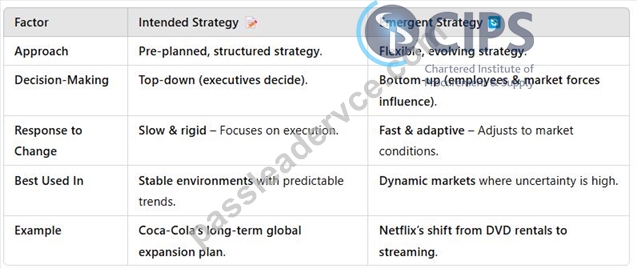
Key Takeaway: Most successful organizations blend both approaches, using intended strategy for stability and emergent strategy for adaptability.
4. Conclusion
Both intended and emergent strategies have strengths and weaknesses.
✅ Intended strategy is best for structured, long-term growth in stable industries.
✅ Emergent strategy allows for rapid adaptation in volatile markets.
✅ Most businesses use a combination of both approaches, balancing planning with flexibility.
By integrating intended and emergent strategies, organizations can maintain stability while responding effectively to market changes.
NEW QUESTION # 19
SIMULATION
Explain the use of forward and future contracts in the commodities market
Answer:
Explanation:
Use of Forward and Futures Contracts in the Commodities Market
Introduction
The commodities market involves the trading of physical goods such as oil, gold, agricultural products, and metals. Due to price volatility, businesses and investors use derivative contracts like forward and futures contracts to manage price risk and ensure stability in supply chains.
Both contracts allow buyers and sellers to agree on a fixed price for a future date, but they differ in terms of standardization, trading methods, and risk exposure.
1. Forward Contracts (Private, Custom Agreements)
Definition
A forward contract is a customized agreement between two parties to buy or sell a commodity at a specified price on a future date. It is a private, over-the-counter (OTC) contract, meaning it is not traded on an exchange.
✅ Key Characteristics:
Customizable terms (quantity, delivery date, price).
Direct agreement between buyer and seller.
Used for hedging against price fluctuations.
Example: A coffee producer agrees to sell 10,000kg of coffee to a distributor in 6 months at a fixed price of $5 per kg, protecting both parties from price swings.
Advantages of Forward Contracts
✔ Tailored to buyer/seller needs - Customizable quantity, quality, and delivery terms.
✔ Reduces price uncertainty - Locks in a price, protecting against market fluctuations.
✔ No upfront cost - No initial margin or collateral required.
Disadvantages of Forward Contracts
❌ High counterparty risk - If one party defaults, the other may face financial losses.
❌ Not regulated or publicly traded - Higher risk of contract disputes.
❌ Limited liquidity - Harder to transfer or sell compared to futures contracts.
Best for: Companies looking for customized price protection in procurement or sales (e.g., food manufacturers, oil refineries).
2. Futures Contracts (Standardized, Exchange-Traded Agreements)
Definition
A futures contract is a standardized agreement to buy or sell a commodity at a predetermined price on a future date. These contracts are traded on organized exchanges (e.g., Chicago Mercantile Exchange (CME), London Metal Exchange (LME)).
✅ Key Characteristics:
Highly regulated and standardized (fixed contract sizes and terms).
Exchange-traded → Increased liquidity and price transparency.
Requires initial margin and daily settlements (mark-to-market system).
Example: A wheat farmer uses futures contracts on the Chicago Board of Trade (CBOT) to lock in wheat prices before harvest, avoiding potential price drops.
Advantages of Futures Contracts
✔ Lower counterparty risk - Exchanges guarantee contract settlement.
✔ High liquidity - Easily bought or sold on futures markets.
✔ Price transparency - Publicly available pricing and standardized contracts.
Disadvantages of Futures Contracts
❌ Less flexibility - Fixed contract sizes and expiration dates.
❌ Margin requirements - Traders must maintain a margin account, requiring cash reserves.
❌ Potential for speculative losses - Prices fluctuate daily, leading to possible margin calls.
Best for: Large-scale buyers/sellers, investors, and companies needing risk management in commodity markets.
3. Key Differences Between Forward and Futures Contracts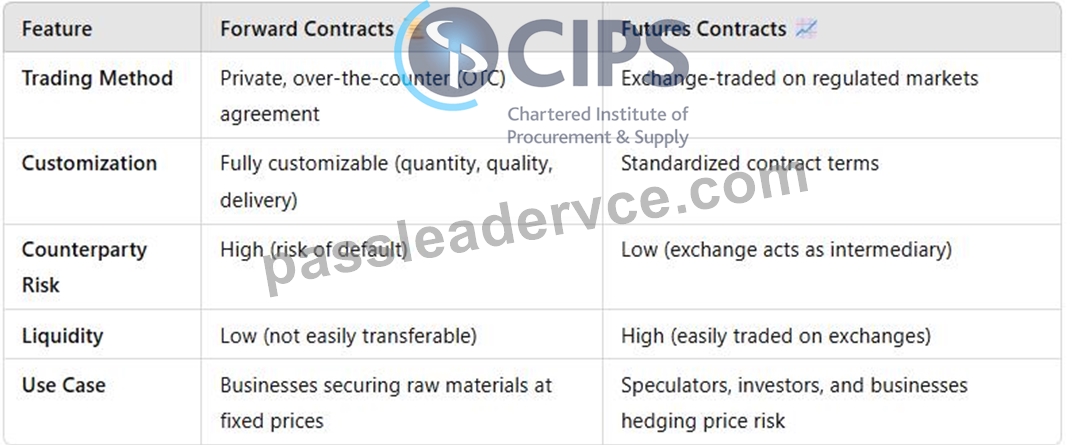
Key Takeaway: Forwards offer flexibility but higher risk, while futures provide standardization and liquidity.
4. Application of Forward and Futures Contracts in the Commodities Market Forwards Used By:
✅ Food manufacturers - Locking in wheat, sugar, or coffee prices for future production.
✅ Oil refineries - Securing crude oil prices to manage fuel costs.
✅ Mining companies - Pre-agreeing on metal prices to secure revenue streams.
Futures Used By:
✅ Airlines - Hedging against fluctuating fuel prices.
✅ Investors - Speculating on gold, oil, or agricultural prices for profit.
✅ Governments - Stabilizing national food or energy reserves.
5. Conclusion
Both forward and futures contracts are essential tools in the commodities market for price risk management.
✅ Forward contracts are customizable but riskier, making them suitable for businesses with specific procurement needs.
✅ Futures contracts offer liquidity and reduced counterparty risk, making them ideal for investors and large corporations managing price volatility.
Organizations must choose the right contract based on their risk tolerance, market exposure, and financial objectives.
NEW QUESTION # 20
SIMULATION
Provide a definition of a commodity product. What role does speculation and hedging play in the commodities market?
Answer:
Explanation:
Commodity Products and the Role of Speculation & Hedging in the Commodities Market
1. Definition of a Commodity Product
A commodity product is a raw material or primary agricultural product that is uniform in quality and interchangeable with other products of the same type, regardless of the producer.
✅ Key Characteristics:
Standardized and homogeneous - Little differentiation between producers.
Traded on global markets - Bought and sold on commodity exchanges.
Price determined by supply & demand - Subject to market fluctuations.
Examples of Commodity Products:
Agricultural Commodities - Wheat, corn, coffee, cotton.
Energy Commodities - Crude oil, natural gas, coal.
Metals & Minerals - Gold, silver, copper, aluminum.
Key Takeaway: Commodities are essential goods used in global trade, where price is the primary competitive factor.
2. The Role of Speculation in the Commodities Market
Definition
Speculation involves buying and selling commodities for profit rather than for actual use, based on price predictions.
✅ How Speculation Works:
Traders and investors buy commodities expecting price increases (long positions).
They sell commodities expecting price declines (short positions).
No physical exchange of goods-transactions are purely financial.
Example:
A trader buys crude oil futures at $70 per barrel, expecting prices to rise. If oil reaches $80 per barrel, the trader sells for profit.
Advantages of Speculation
✔ Increases market liquidity - More buyers and sellers improve trading efficiency.
✔ Enhances price discovery - Helps determine fair market value.
✔ Absorbs market risk - Speculators take risks that producers or consumers avoid.
Disadvantages of Speculation
❌ Creates excessive volatility - Large speculative trades can cause price spikes or crashes.
❌ Detaches prices from real supply and demand - Can inflate bubbles or cause artificial declines.
❌ Market manipulation risks - Speculators with large holdings can distort prices.
Key Takeaway: Speculation adds liquidity and helps price discovery, but can lead to extreme volatility if unchecked.
3. The Role of Hedging in the Commodities Market
Definition
Hedging is a risk management strategy used by commodity producers and consumers to protect against price fluctuations.
✅ How Hedging Works:
Producers (e.g., farmers, oil companies) use futures contracts to lock in a price for future sales, reducing the risk of price drops.
Consumers (e.g., airlines, food manufacturers) hedge to secure stable input costs, avoiding sudden price surges.
Example:
An airline hedges against rising fuel costs by buying fuel futures at a fixed price for the next 12 months. If fuel prices rise, the airline is protected from increased expenses.
Advantages of Hedging
✔ Stabilizes revenue and costs - Helps businesses plan with certainty.
✔ Protects against price swings - Reduces exposure to unpredictable market conditions.
✔ Encourages long-term investment - Producers and buyers operate with confidence.
Disadvantages of Hedging
❌ Reduces potential profits - If prices move favorably, hedgers miss out on gains.
❌ Contract obligations - Hedgers must honor contract terms, even if market prices improve.
❌ Hedging costs - Fees and contract costs can be high.
Key Takeaway: Hedging protects businesses from commodity price risk, ensuring stable revenue and cost control.
4. Speculation vs. Hedging: Key Differences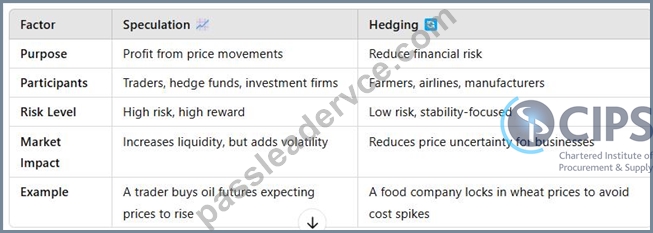
Key Takeaway: Speculation seeks profit from price changes, while hedging minimizes risk from price fluctuations.
5. Conclusion
✅ Commodity products are standardized raw materials traded globally, with prices driven by supply and demand dynamics.
✅ Speculation brings liquidity and price discovery but can increase volatility.
✅ Hedging helps businesses stabilize costs and revenues, ensuring financial predictability.
✅ Both strategies play essential roles in ensuring a balanced, functional commodities market.
NEW QUESTION # 21
......
Our PassLeaderVCE L6M2 exam materials provide all candidates with available free Demo. Before you decide to purchase L6M2 exam materials, we suggest that you should download our Demo. You can check for free demos to see if our exam questions contain what you need for the L6M2 exam, and you can view other exam applicants' experiences by using our exam materials. Tested and verified - Our L6M2 Exam Materials were trusted by thousands of candidates. You can visit our recommendation section and read the first-hand experience of verified users. Our L6M2 exam materials will help you figure out what the actual product will provide you, and whether these features will help future users learn within a week and pass the exam successfully.
Exam L6M2 Questions Answers: https://www.passleadervce.com/CIPS-Certification/reliable-L6M2-exam-learning-guide.html
- Exam L6M2 Flashcards 👡 L6M2 Practice Engine 😕 L6M2 Test Vce Free 📬 Go to website ⏩ www.testkingpdf.com ⏪ open and search for ⏩ L6M2 ⏪ to download for free 🔗Exam L6M2 Details
- 2025 Reliable L6M2 Exam Bootcamp | Reliable L6M2: Global Commercial Strategy 100% Pass 🥥 Enter ⏩ www.pdfvce.com ⏪ and search for ➥ L6M2 🡄 to download for free 😄L6M2 Valid Test Registration
- L6M2: Global Commercial Strategy torrent - Pass4sure L6M2 valid exam questions 🧀 Search on ⇛ www.pass4leader.com ⇚ for [ L6M2 ] to obtain exam materials for free download 🚉Latest L6M2 Study Guide
- Get Success in CIPS L6M2 Exam Questions and Grow Your Career 😿 Enter 「 www.pdfvce.com 」 and search for ▛ L6M2 ▟ to download for free 💋Latest L6M2 Dumps Free
- Pass Guaranteed Quiz 2025 Accurate L6M2: Reliable Global Commercial Strategy Exam Bootcamp 🤷 Open ▛ www.exams4collection.com ▟ and search for ➤ L6M2 ⮘ to download exam materials for free 🍼Latest L6M2 Dumps Free
- Exam L6M2 Flashcards 👫 Latest L6M2 Dumps Free 📍 Clear L6M2 Exam 👦 Copy URL ▷ www.pdfvce.com ◁ open and search for ✔ L6M2 ️✔️ to download for free 🤺Valid L6M2 Exam Testking
- L6M2 Test Valid 🍷 L6M2 Guaranteed Passing 🐕 L6M2 Valid Test Registration 🧜 Easily obtain [ L6M2 ] for free download through “ www.lead1pass.com ” 🏂Exam L6M2 Details
- 2025 Reliable L6M2 Exam Bootcamp: Global Commercial Strategy - High-quality CIPS Exam L6M2 Questions Answers 🌊 Search for ( L6M2 ) and download it for free immediately on ➡ www.pdfvce.com ️⬅️ 🤳L6M2 Exam Pattern
- L6M2: Global Commercial Strategy torrent - Pass4sure L6M2 valid exam questions 🎿 The page for free download of { L6M2 } on ( www.torrentvce.com ) will open immediately 🔸L6M2 Brain Exam
- Exam L6M2 Details 💸 L6M2 Test Vce Free 🕟 Valid L6M2 Cram Materials 🛺 The page for free download of [ L6M2 ] on ➤ www.pdfvce.com ⮘ will open immediately 🚰Latest L6M2 Dumps Free
- L6M2 Guaranteed Questions Answers 🥅 L6M2 Reliable Braindumps Book 📉 L6M2 Reliable Braindumps Book 👵 Simply search for 《 L6M2 》 for free download on ☀ www.real4dumps.com ️☀️ 🧊Latest L6M2 Dumps Free
- digividya.online, elearning.eauqardho.edu.so, superstudentedu.com, bbs.ntpcb.com, academy.vandtel.com, mpgimer.edu.in, school.celebrationministries.com, learnhub.barokathi.xyz, globalcareco.com, motionentrance.edu.np
